About ukes
The little instrument you're building has traveled a long way: from Portuguese farm villages to a Hawaiian royal court, to a San Francisco world's fair, to millions of American living rooms — twice. And the light wooden skeleton under its top, the bracing you'll cut and glue in Session 3, carries its own quiet history. Here's the short version.
From Madeira to Hawaiʻi, 1878–79
The ukulele didn't start in Hawaiʻi — it landed there. In the late 1870s, contract laborers sailed from the Portuguese island of Madeira to work Hawaiʻi's sugar plantations. They brought small folk instruments with them:
- The machete, a small four-string treble guitar (the ordinary 19th-century name; "braguinha" seems to be a later diminutive).
- The rajão, a larger five-string instrument tuned re-entrant D–G–C–E–A. Standard ukulele tuning — G–C–E–A — matches the rajão's first four strings, which is the strongest evidence the uke descends more from the rajão than from the machete.
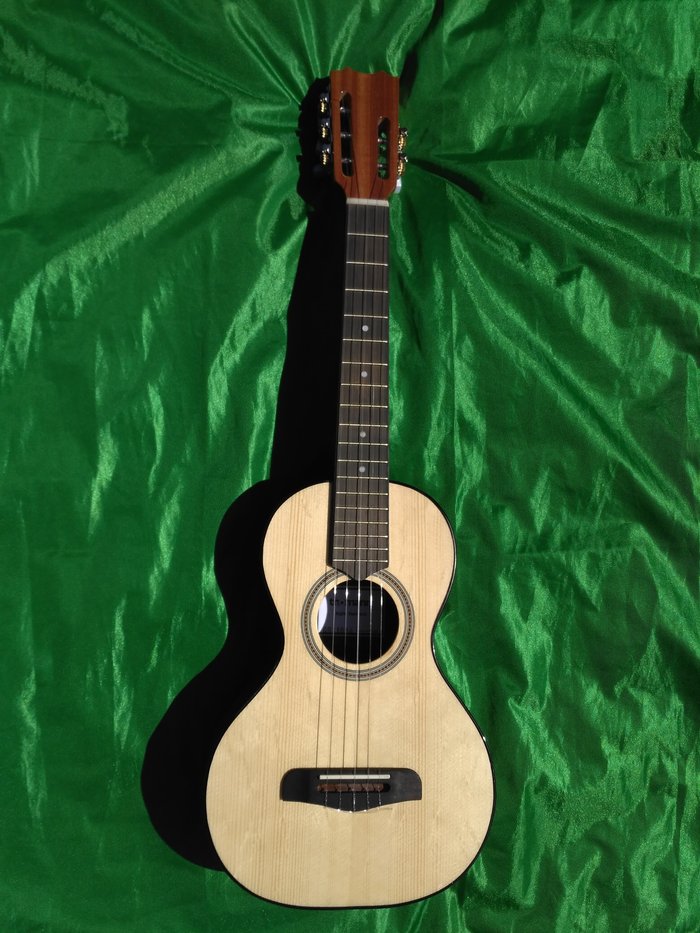
The documented ships are the Priscilla (September 1878, 123 Madeiran workers) and the Ravenscrag (1879, more than 420). Contemporary newspaper accounts describe the newly arrived Madeirans giving nightly street concerts as a band — so the famous story of one man jumping off the ship playing a solo is better treated as tradition than as the whole story.
The first makers on record were three Madeiran cabinetmakers — emigration records say cabinetmakers, not trained luthiers: Augusto Dias, Manuel Nunes, and José do Espírito Santo. Dias appears in Honolulu's 1884 city directory as a guitar and furniture maker; by August 1885 Dias and Nunes were advertising guitars and machetes together. They adapted the design to Hawaiʻi, most notably by building from native hardwoods like koa instead of European spruce.
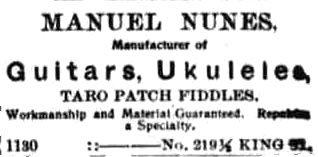
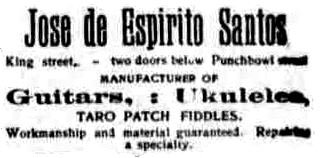
Royal patronage sealed the instrument's place: King Kalākaua (reigned 1874–1891) promoted it at court, and Queen Liliʻuokalani later called it "our instrument, the ukulele." (One thing not to repeat: there's no evidence she composed "Aloha ʻOe" on a ukulele.) Samuel Kamaka Sr. founded his shop in 1916 after apprenticing with Nunes, developed the oval pineapple body around 1926–27, and patented it in 1928.
Why "ukulele"?
Nobody knows for certain. The leading theories:
- "Jumping flea" (ʻuku + lele), for the quick fingerwork — the first instrument-specific explanation appears in Ernest Kaʻai's 1910 ukulele method.
- Edward Purvis, the king's small, quick vice-chamberlain — challenged by modern scholarship as unlikely.
- "The gift that came here" (ʻuku = reward/gift, lele = to come) — a later tradition, not a linguistic consensus.
The earliest known printed "ukelele" is from an 1890 account of a Honolulu visit; the preferred spelling "ʻukulele" shows up by 1895.
The first American craze, 1915
The Panama-Pacific International Exposition opened in San Francisco on February 20, 1915. The Hawaiian Pavilion's daily music-and-hula shows put the ukulele in front of millions of fairgoers — and the mainland fell for it. A Tin Pan Alley wave of pseudo-Hawaiian sheet music followed, vaudeville acts picked up the instrument, and Hawaiian makers' output is estimated to have jumped from a few hundred instruments a month to around 1,600 within a year.
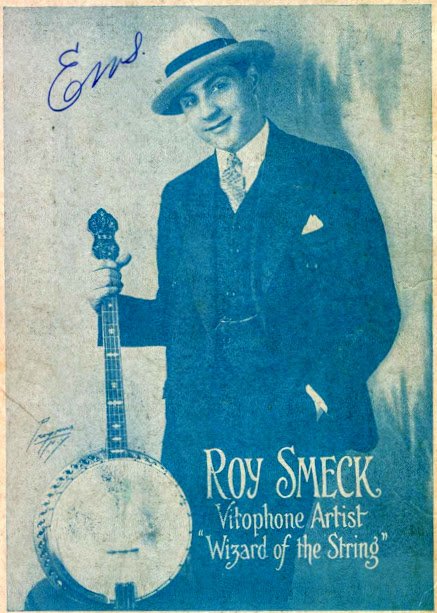
The stars of the craze: Cliff Edwards ("Ukulele Ike"), Roy Smeck ("Wizard of the Strings"), and May Singhi Breen ("Ukulele Lady"), who carried the instrument onto radio and into print. Jonah Kumalae's koa ukuleles won a gold award at the exposition itself, which helped Hawaiian instruments reach mainland buyers.
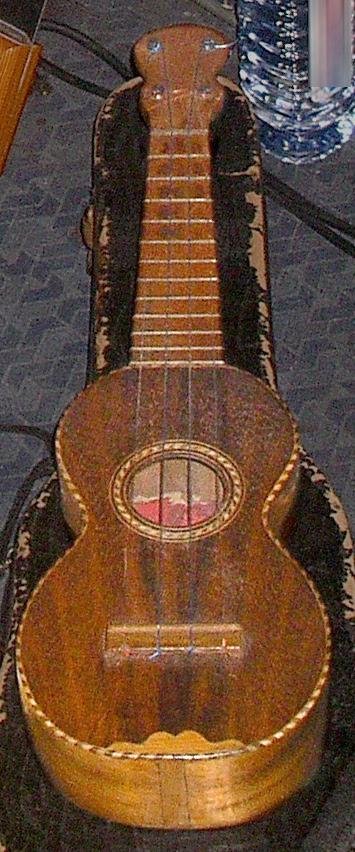
Martin and Gibson join in
Martin had built a few ukuleles as early as 1906, but only began serious production with the post-exposition demand of 1915–16, first cataloguing ukuleles in 1917. The soprano Styles 0 through 3 (plus koa 2K, deluxe 5/5K, and the eight-string Taropatch) became the industry's reference instruments; the concert size arrived in 1925 and the tenor — the size you're building — in 1929. Martin's ukulele output peaked around 1926. Gibson entered around 1926–27 with the Uke-1, Uke-2, Uke-3, and the TU tenor, in dark-stained mahogany rather than Martin's koa.
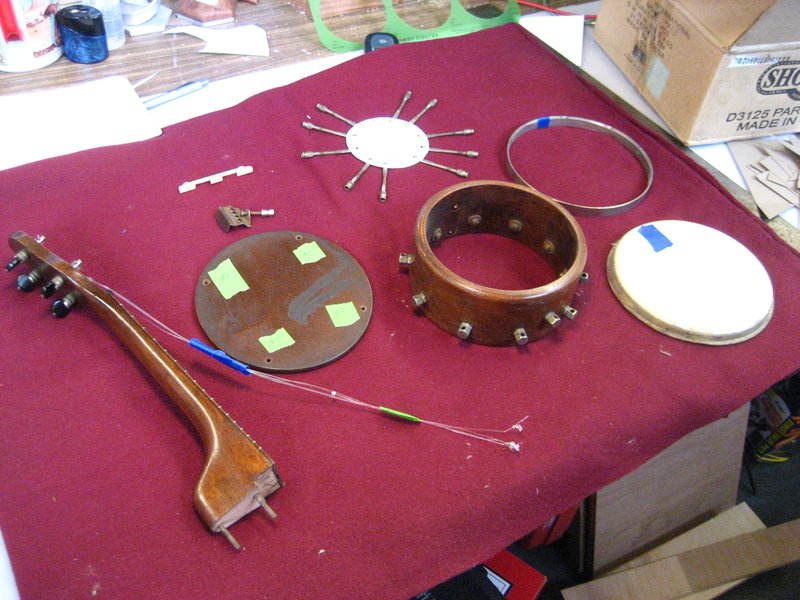
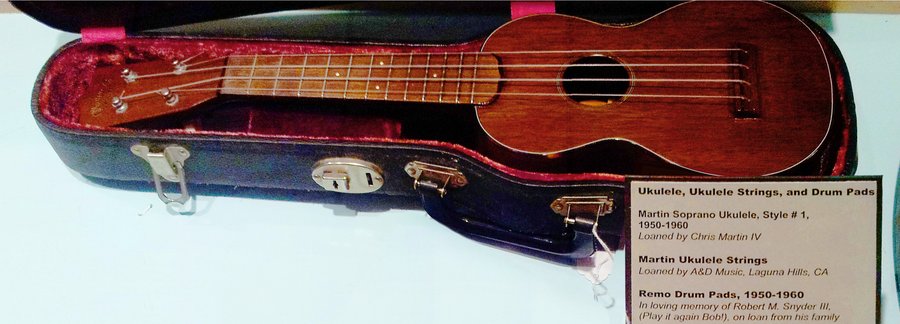
The first craze faded by the late 1930s. It's tempting to blame the Depression outright, but the story is mixed — cheap ukuleles were an affordable pleasure in hard times, and Martin's uke sales reportedly helped keep the company going.
The second wave: TV and plastic
Arthur Godfrey, one of early television's biggest stars (reaching an estimated 40 million people), took up the ukulele on the radio, gave televised lessons to millions in 1950, and ran a twice-weekly instructional show. His endorsement turned luthier Mario Maccaferri's molded-plastic "Islander" ukulele (1949) into a mass product: cheap, consistent, and humidity-proof, it sold over 9 million before Maccaferri sold the business in 1969.
Tiny Tim rode Rowan & Martin's Laugh-In to national fame in 1968, and "Tiptoe Through the Tulips" peaked at No. 17 that June — but he was a camp spectacle rather than a sales engine, and he himself said a professional played the ukulele on the studio recording.
The modern revival
The instrument's third act began in Hawaiʻi. Israel Kamakawiwoʻole (1959–1997), co-founder of the Mākaha Sons of Niʻihau, recorded an impromptu single-take medley of "Somewhere Over the Rainbow / What a Wonderful World" at 3 a.m. in 1988; it anchored his 1993 album Facing Future, which became the best-selling album by a Hawaiian artist, went platinum in 2005, and entered the U.S. National Recording Registry in 2021. It's probably the single most-heard ukulele recording in history.
Then the internet did the rest. In 2006, a video of Jake Shimabukuro playing "While My Guitar Gently Weeps" in Central Park went viral on early YouTube and launched his international career — proof that the little instrument could hold a world stage. The numbers followed: U.S. ukulele sales rose 16% in 2010 and 54% in 2011, and in the UK the share of school music students playing ukulele went from about 1% in 1997 to 15% around 2020. Better cheap instruments sealed it: this time the craze had staying power.
How the top got its bones: bracing
A ukulele top is a thin sheet of softwood with four strings trying to pull the bridge forward and rotate it off the top. Bracing — the light bars glued inside — does two jobs at once: it keeps the top from warping or bellying under that pull, and it stiffens the right places while adding as little mass as possible, so the top can still move and make sound. Too much bracing makes a stiff, quiet top; too little makes a top that fails. Every pattern below is a different answer to that trade.
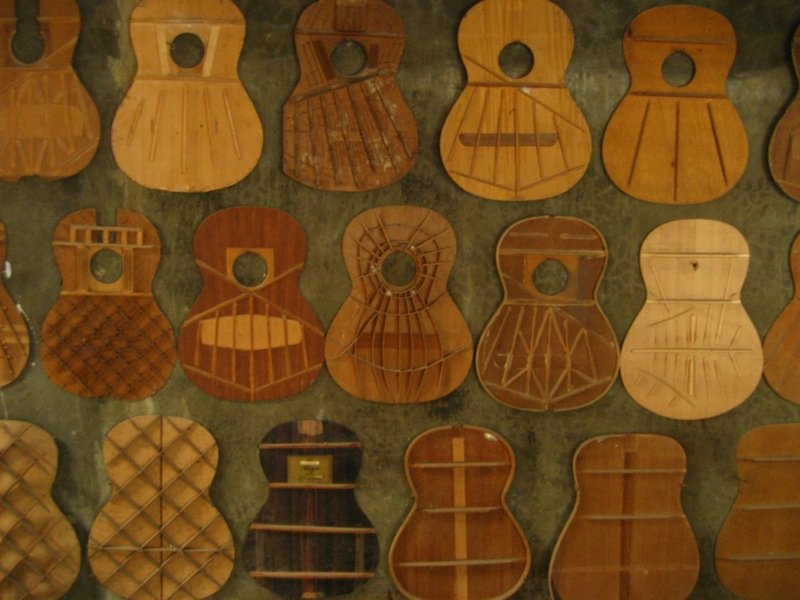
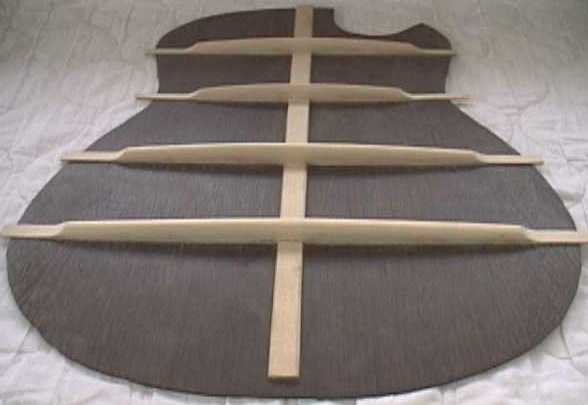
Transverse / ladder
Straight bars across the grain — the traditional pattern of the early Hawaiian makers and low-tension gut-string instruments. Simple, light, and honest. (Shown: a steel-string guitar back; the pattern is the point. No published interior survey of the very earliest instruments exists, so this is inferred from surviving instruments rather than a documented 19th-century spec.)
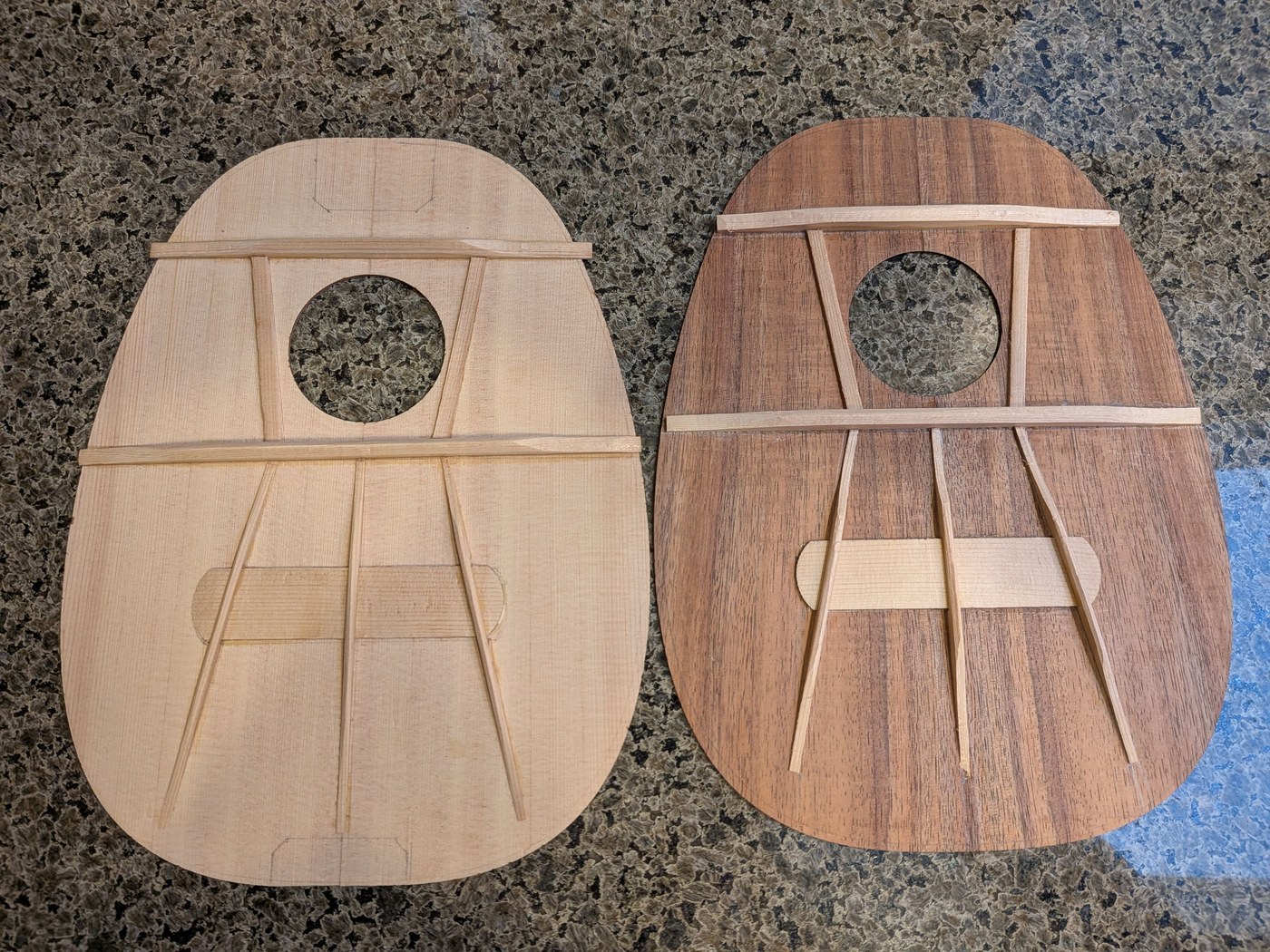
Fan
Borrowed from the classical guitar, where Antonio de Torres codified it in the mid-1800s. Short braces radiate from the bridge region, freeing the lower bout to move. Traditional fan struts are straight — the curved, swooping braces you sometimes see in modern tops are falcate bracing, a different animal. Fan-style bracing turns up inside early-1960s Martin baritone ukuleles. (Shown: two fan-braced tenor tops — spruce and koa — from the instructor's bench.)
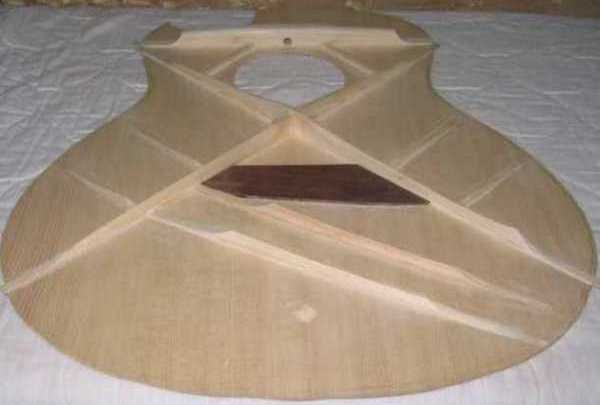
X
Two long braces crossing below the soundhole, triangulating the bridge zone. C. F. Martin's innovation for gut-string guitars in the 1840s; on ukuleles it appears on larger, higher-tension, or steel-string instruments. No verified date or maker for the first X-braced ukulele exists — and the real history is parallel traditions, not a tidy ladder→fan→X progression.
The modern experiments
- Kasha bracing — an asymmetric field of many small braces (with an offset soundhole), used experimentally by custom builders to manage stiffness distribution.
- Falcate bracing — curved, paired braces (often spruce/carbon-fiber laminates), adapted from contemporary guitar work associated with Trevor Gore and Gerard Gilet; experimental on ukuleles.
- Kanileʻa's TRU-R — a patented openwork "touch and release" brace system developed by Joe Souza: the braces touch less of the top, cutting mass while keeping structure. Treat the tonal claims as the maker's, not settled acoustics.
What you'll build in class
Session 3 uses a proven light pattern in the traditional spirit: an upper transverse brace near the soundhole, a main transverse brace at the bridge zone, three small fan braces fanning below the bridge, and a bridge plate under the bridge spreading its load. Four nylon strings pull far less than steel, so a classic ukulele needs less bracing than a steel-string guitar — the common beginner error is over-building. Keep everything light and taper the brace ends.
Myths & murky bits
"Nunes invented the ukulele." No — three documented maker-shops, no sole-inventor evidence.
"The makers were trained luthiers." Their emigration records say cabinetmakers.
"Martin started ukuleles in 1915." Distinguish 1906 experiments, 1915–16 production, and the 1917 catalogue.
"Bracing evolved ladder → fan → X." Oversimplified — the traditions ran in parallel, and no verified first-X-braced ukulele date exists.
Hawaiian production "500–600 to 1,600 instruments a month" (1915–16). A contemporary estimate, not audited data.
Sources
- King, John & Tranquada, Jim. "A New History of the Origins and Development of the 'Ukulele, 1838–1915." The Hawaiian Journal of History, vol. 37 (2003) — the scholarly backbone for origins, makers, tuning, and name theories.
- University of Hawaiʻi, Mālamalama (2007) — royal patronage, Kaʻai, Liliʻuokalani, and the craze stars. hawaii.edu
- Ukulele Magazine (historian Jim Tranquada) — the 1915 expo and the first craze; Arthur Godfrey; Maccaferri; Gibson ukes. ukulelemagazine.com
- Martin company archives via Ukulele Magazine, Fretboard Journal, Collectors Weekly — 1906 builds vs. 1917 catalogue, model chronology.
- FRETS.com glossary (Frank Ford) — bracing definitions and the X/fan-bracing attributions. frets.com
- StewMac tenor ukulele bracing plan (PDF) — a beginner-ready build reference. stewmac.com
- NAMM.org press releases; Music Trades via NAMM — 2010s sales data. namm.org
Photo credits
- Rajão: Gvapolanda Respublika, CC BY 4.0 (Wikimedia Commons).
- Guitar-top wall: suvajack, CC BY 2.0 (Wikimedia Commons).
- Fan-braced tenor tops: Doug Salot (the instructor's own bench).
- X bracing: Zanthorp, CC BY-SA 3.0 (Wikimedia Commons).
- Martin Style 1 soprano: doryfour, CC BY-SA 2.0 (Wikimedia Commons).
- Gibson UB-1 banjo ukulele: switthoft, CC BY 2.0 (Wikimedia Commons).
- Vintage Hawaiian ukulele: Wikimedia Commons, CC BY-SA 3.0.
- Ladder bracing, the Nunes and do Espírito Santo ads, and the Roy Smeck 1926 sheet-music cover: public domain (Wikimedia Commons).